
[Feature Request] Allow WindowModal to exclude transient top-level windows from modal blocking
-
Title
[Feature Request] Allow WindowModal to exclude transient top-level windows from modal blocking
Description
Qt::WindowModalcurrently treats transient parents as part of the modal window hierarchy.This can be problematic when a transient/owned top-level window is used for Z-order and lifetime management, but is intended to remain interactive while a modal dialog is open for another top-level window.
Example
Consider two independent top-level windows:
A = main/document window
B = independent tool window
B is a top-level window and has a transient relationship with A.
The transient relationship is used for:
- keeping B above A;
- following A's minimize/restore behavior;
- following A's visibility/lifetime;
- maintaining the desired relationship between the two windows.
Now A opens a
Qt::WindowModaldialog C:C │ ▼ A │ BThe desired behavior is:
C blocks A
C does not block B
However, B is currently considered part of A's modal hierarchy because Qt's
WindowModalimplementation follows transient parents.As a result:
C blocks A
C also blocks B
Relevant Qt API
Qt already has an explicit distinction between normal parent relationships and transient-parent relationships:
enum AncestorMode {
    ExcludeTransients,
    IncludeTransients
};
The documentation for
QWindow::AncestorModestates thatExcludeTransientsmeans that transient parents are not considered ancestors.QWindow::isAncestorOf()andQWindow::parent()support this distinction.However,
QGuiApplicationPrivate::isWindowBlocked()currently uses the transient relationship when calculatingQt::WindowModalblocking.In Qt 5, see:
qtbase/src/gui/kernel/qguiapplication.cpp

QGuiApplicationPrivate::isWindowBlocked()
The
Qt::WindowModalimplementation walks bothparent()andtransientParent().In Qt 6, the implementation explicitly uses:
QWindow::IncludeTransientsfor the
WindowModalancestor checks:if (current->isAncestorOf(modalWindow, QWindow::IncludeTransients)) { ... } current = current->parent(QWindow::IncludeTransients);Therefore, the current implementation effectively couples:
transient-parent relationship
        +
WindowModal blocking hierarchy
These relationships are not necessarily equivalent.
Why this matters
A transient relationship can be needed purely for window-management purposes:
A <---- transient ----> B

Purpose:
    Z-order
    minimize/restore
    lifetime
while the desired modal relationship may be:
C ---- modal ----> A

C blocks:
    A

C does not block:
    B
In other words:
Z-order/lifetime hierarchy
        !=
modal input-blocking hierarchy
Proposed behavior
I suggest providing a way for applications to opt out of transient windows participating in
WindowModalblocking.For example, conceptually:
dialog->setWindowModality(Qt::WindowModal);
dialog->setModalAncestorMode(QWindow::ExcludeTransients);
or another API with equivalent semantics.
The important point is that this should be opt-in, so existing applications retain the current behavior.
Minimal implementation experiment
The existing implementation can be demonstrated with a very small change.
In the Qt 6 implementation, the relevant code currently uses:
QWindow::IncludeTransientsfor
WindowModal.As an experiment, replacing the relevant
WindowModalancestor traversal with:QWindow::ExcludeTransientsmakes transient top-level windows no longer participate in the modal hierarchy.
This is not necessarily proposed as the final API/patch, but it demonstrates that Qt already has the necessary ancestor semantics internally.
For Qt 5, the equivalent minimal experiment is to make the
WindowModaltraversal follow only:QWindow::parent()and not:
QWindow::transientParent()Possible patch direction
A minimal API could be an opt-in property controlling the ancestor mode used by
WindowModal.For example:
class QWindow
{
public:
    enum ModalAncestorMode {
        IncludeTransientParents,
        ExcludeTransientParents
    };

    void setModalAncestorMode(ModalAncestorMode mode);
    ModalAncestorMode modalAncestorMode() const;
};
Then
QGuiApplicationPrivate::isWindowBlocked()could use that mode when processingQt::WindowModal.Alternatively, an API at the application/dialog level could expose the same choice.
Compatibility consideration
I do not suggest changing the existing default behavior unconditionally.
There may be applications that intentionally rely on transient windows being blocked together with their parent.
The feature could therefore default to the current behavior:
WindowModal
    -> IncludeTransients
while allowing applications with independent top-level tool windows to request:
WindowModal
    -> ExcludeTransients
Minimal reproduction
A minimal reproduction would consist of:
A: top-level window
B: independent top-level window with transientParent(A)
C: WindowModal dialog for A
Expected:
C blocks A
B remains interactive
Actual:
C blocks A
B is also blocked
This issue is not about
WindowStaysOnTopHintor global always-on-top behavior.The requirement is specifically to use the transient relationship for window-management/Z-order purposes while keeping the modal input-blocking hierarchy independent from that relationship.
Would an API allowing
WindowModalto useExcludeTransientsbe considered reasonable? -
Title
[Feature Request] Allow WindowModal to exclude transient top-level windows from modal blocking
Description
Qt::WindowModalcurrently treats transient parents as part of the modal window hierarchy.This can be problematic when a transient/owned top-level window is used for Z-order and lifetime management, but is intended to remain interactive while a modal dialog is open for another top-level window.
Example
Consider two independent top-level windows:
A = main/document window
B = independent tool window
B is a top-level window and has a transient relationship with A.
The transient relationship is used for:
- keeping B above A;
- following A's minimize/restore behavior;
- following A's visibility/lifetime;
- maintaining the desired relationship between the two windows.
Now A opens a
Qt::WindowModaldialog C:C │ ▼ A │ BThe desired behavior is:
C blocks A
C does not block B
However, B is currently considered part of A's modal hierarchy because Qt's
WindowModalimplementation follows transient parents.As a result:
C blocks A
C also blocks B
Relevant Qt API
Qt already has an explicit distinction between normal parent relationships and transient-parent relationships:
enum AncestorMode {
    ExcludeTransients,
    IncludeTransients
};
The documentation for
QWindow::AncestorModestates thatExcludeTransientsmeans that transient parents are not considered ancestors.QWindow::isAncestorOf()andQWindow::parent()support this distinction.However,
QGuiApplicationPrivate::isWindowBlocked()currently uses the transient relationship when calculatingQt::WindowModalblocking.In Qt 5, see:
qtbase/src/gui/kernel/qguiapplication.cpp

QGuiApplicationPrivate::isWindowBlocked()
The
Qt::WindowModalimplementation walks bothparent()andtransientParent().In Qt 6, the implementation explicitly uses:
QWindow::IncludeTransientsfor the
WindowModalancestor checks:if (current->isAncestorOf(modalWindow, QWindow::IncludeTransients)) { ... } current = current->parent(QWindow::IncludeTransients);Therefore, the current implementation effectively couples:
transient-parent relationship
        +
WindowModal blocking hierarchy
These relationships are not necessarily equivalent.
Why this matters
A transient relationship can be needed purely for window-management purposes:
A <---- transient ----> B

Purpose:
    Z-order
    minimize/restore
    lifetime
while the desired modal relationship may be:
C ---- modal ----> A

C blocks:
    A

C does not block:
    B
In other words:
Z-order/lifetime hierarchy
        !=
modal input-blocking hierarchy
Proposed behavior
I suggest providing a way for applications to opt out of transient windows participating in
WindowModalblocking.For example, conceptually:
dialog->setWindowModality(Qt::WindowModal);
dialog->setModalAncestorMode(QWindow::ExcludeTransients);
or another API with equivalent semantics.
The important point is that this should be opt-in, so existing applications retain the current behavior.
Minimal implementation experiment
The existing implementation can be demonstrated with a very small change.
In the Qt 6 implementation, the relevant code currently uses:
QWindow::IncludeTransientsfor
WindowModal.As an experiment, replacing the relevant
WindowModalancestor traversal with:QWindow::ExcludeTransientsmakes transient top-level windows no longer participate in the modal hierarchy.
This is not necessarily proposed as the final API/patch, but it demonstrates that Qt already has the necessary ancestor semantics internally.
For Qt 5, the equivalent minimal experiment is to make the
WindowModaltraversal follow only:QWindow::parent()and not:
QWindow::transientParent()Possible patch direction
A minimal API could be an opt-in property controlling the ancestor mode used by
WindowModal.For example:
class QWindow
{
public:
    enum ModalAncestorMode {
        IncludeTransientParents,
        ExcludeTransientParents
    };

    void setModalAncestorMode(ModalAncestorMode mode);
    ModalAncestorMode modalAncestorMode() const;
};
Then
QGuiApplicationPrivate::isWindowBlocked()could use that mode when processingQt::WindowModal.Alternatively, an API at the application/dialog level could expose the same choice.
Compatibility consideration
I do not suggest changing the existing default behavior unconditionally.
There may be applications that intentionally rely on transient windows being blocked together with their parent.
The feature could therefore default to the current behavior:
WindowModal
    -> IncludeTransients
while allowing applications with independent top-level tool windows to request:
WindowModal
    -> ExcludeTransients
Minimal reproduction
A minimal reproduction would consist of:
A: top-level window
B: independent top-level window with transientParent(A)
C: WindowModal dialog for A
Expected:
C blocks A
B remains interactive
Actual:
C blocks A
B is also blocked
This issue is not about
WindowStaysOnTopHintor global always-on-top behavior.The requirement is specifically to use the transient relationship for window-management/Z-order purposes while keeping the modal input-blocking hierarchy independent from that relationship.
Would an API allowing
WindowModalto useExcludeTransientsbe considered reasonable?@Aidener said in [Feature Request] Allow WindowModal to exclude transient top-level windows from modal blocking:
B = independent tool window
Don't make A the parent of B if you really mean "independent" tool window. Just pass
nullptras parent to B. If you usingWindowModalinstead ofAppModalthis should work. But I see your point about visibility and lifetime.BTW, I don't think that AI made your feature request any better. Longer text does not necessarily better provides the point of your feature request. The way you told AI what feature you expect would have been a lot more helpful for us (I guess). The AI just gave the general structure for a proposal. The "minimal implementation experiment" is not an experiment because it does not contain any real source code (you'd have to fill that section yourself). The "possible patch direction" is still incomplete (it is only half the patch). And the "minimal reproduction" is no reproduction at all because it does not contain any source code that could be tested. Again, you'd have to fill out that section yourself. I am quite annoyed by people just posting AI slop. At least turn on your brain and check the output of AI (and modify it to make it suitable for the target audience). (I just tried it: Even AI cannot summerize your post and get to the key points.)
-
@Aidener said in [Feature Request] Allow WindowModal to exclude transient top-level windows from modal blocking:
B = independent tool window
Don't make A the parent of B if you really mean "independent" tool window. Just pass
nullptras parent to B. If you usingWindowModalinstead ofAppModalthis should work. But I see your point about visibility and lifetime.BTW, I don't think that AI made your feature request any better. Longer text does not necessarily better provides the point of your feature request. The way you told AI what feature you expect would have been a lot more helpful for us (I guess). The AI just gave the general structure for a proposal. The "minimal implementation experiment" is not an experiment because it does not contain any real source code (you'd have to fill that section yourself). The "possible patch direction" is still incomplete (it is only half the patch). And the "minimal reproduction" is no reproduction at all because it does not contain any source code that could be tested. Again, you'd have to fill out that section yourself. I am quite annoyed by people just posting AI slop. At least turn on your brain and check the output of AI (and modify it to make it suitable for the target audience). (I just tried it: Even AI cannot summerize your post and get to the key points.)
@SimonSchroeder said in [Feature Request] Allow WindowModal to exclude transient top-level windows from modal blocking:
BTW, I don't think that AI made your feature request any better.
tbh - I don't read such stuff at all anymore, it's to much with no real information. Just bloated AI slop.
-
Re: [Feature Request] Allow WindowModal to exclude transient top-level windows from modal blocking
I am So sory for reply lately. Using Ai just for saving the time and hope to statement clearly but seem as not well. This is Minimal code to show my question. Somebody try and comment will be appreciateed!
#include <QApplication>
#include <QMainWindow>
#include <QDialog>
#include <QPushButton>
#include <QVBoxLayout>
#include <QWindow>

#define SECTION_USE_setTransientParent

int main(int argc, char* argv[])
{
    QApplication app(argc, argv);

    QMainWindow* mainWindow = new QMainWindow;
    mainWindow->setWindowTitle("A - MainWindow");
    mainWindow->resize(400, 300);

    auto* openButton = new QPushButton(
        "Open WindowModal Dialog",
        mainWindow
    );
    mainWindow->setCentralWidget(openButton);

    // B: A top level Dialog for message. example for license, global tip for document
    // Sometimes we need to show some unimportant message and just affirm when user is free
    QDialog* TipDialog = new QDialog(); //parent NULL for C with Qt::WindowModal can not block it.
    TipDialog->setWindowTitle("B - Non-modal Dialog");
    TipDialog->setModal(false);
    TipDialog->setWindowModality(Qt::NonModal);
    TipDialog->resize(250, 150);

    auto* toolButton = new QPushButton("Click B");
    auto* toolLayout = new QVBoxLayout(TipDialog);
    toolLayout->addWidget(toolButton);

#ifdef SECTION_USE_setTransientParent
    // set B -> A transient relationship
    TipDialog->winId(); //Just for get windwow hwd. Another way By Using show() instead.
    mainWindow->winId();
    //keep TipDialog always over mainWindow and
    //Z-order : lower with mainWindow when other process activate
    //minimize / restore
    //attention that setWindowFlags(windowFlags() | Qt::WindowStaysOnTopHint) can not get the same result
    TipDialog->windowHandle()->setTransientParent(
        mainWindow->windowHandle()
    );
#else
    //nothing
    //TipDialog is independent but as a message dialog, it is unaccepted
    // when other process activate and show inside of TipDialog and mainWindow.
    TipDialog->setWindowFlags(TipDialog->windowFlags() | Qt::WindowStaysOnTopHint);
#endif

    // C:  WindowModal Dialog of MainWindow
    QObject::connect(openButton, &QPushButton::clicked, [&] {
        //as child of MainWindow. Sometimes like the QMessageBox::Information but excec() was Qt::ApplicationModal
        auto* dialog = new QDialog(mainWindow);
        dialog->setWindowTitle("C - WindowModal");
        auto* closeButton = new QPushButton("Close", dialog);
        auto* layout = new QVBoxLayout(dialog);
        layout->addWidget(closeButton);

        QObject::connect(
            closeButton,
            &QPushButton::clicked,
            dialog,
            &QDialog::accept
        );

        dialog->setWindowModality(Qt::WindowModal); //only block itself and parent window
        dialog->open(); //this calls will block B out of expectation
        });

    mainWindow->show();

    TipDialog->move(
        mainWindow->x() + mainWindow->width() + 20,
        mainWindow->y()
    );
    TipDialog->show();

    return app.exec();
}
After compiling it will show like that.
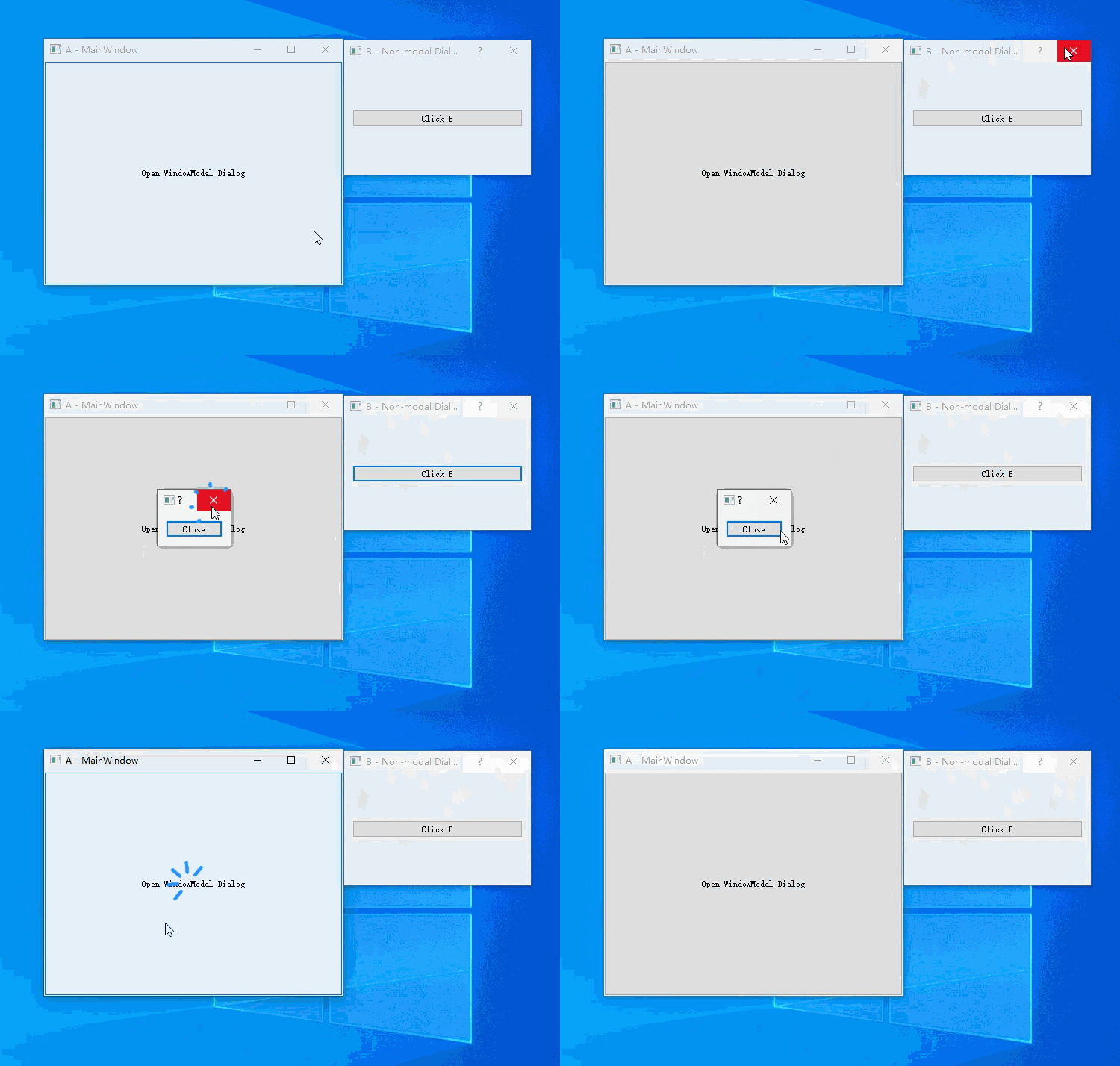
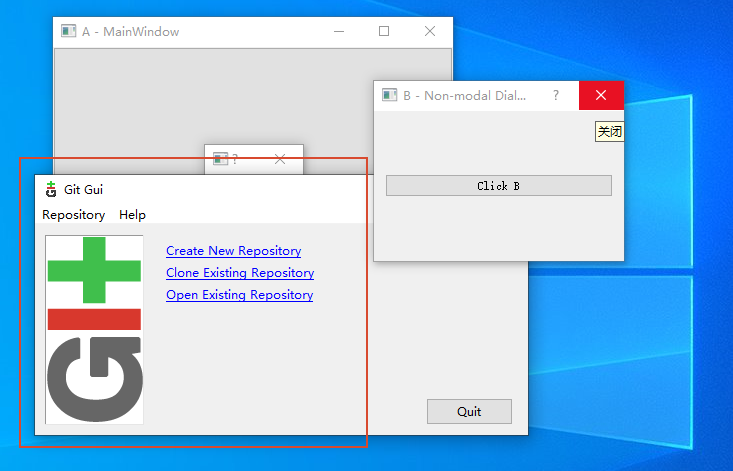
-
Re: [Feature Request] Allow WindowModal to exclude transient top-level windows from modal blocking
I am So sory for reply lately. Using Ai just for saving the time and hope to statement clearly but seem as not well. This is Minimal code to show my question. Somebody try and comment will be appreciateed!
#include <QApplication>
#include <QMainWindow>
#include <QDialog>
#include <QPushButton>
#include <QVBoxLayout>
#include <QWindow>

#define SECTION_USE_setTransientParent

int main(int argc, char* argv[])
{
    QApplication app(argc, argv);

    QMainWindow* mainWindow = new QMainWindow;
    mainWindow->setWindowTitle("A - MainWindow");
    mainWindow->resize(400, 300);

    auto* openButton = new QPushButton(
        "Open WindowModal Dialog",
        mainWindow
    );
    mainWindow->setCentralWidget(openButton);

    // B: A top level Dialog for message. example for license, global tip for document
    // Sometimes we need to show some unimportant message and just affirm when user is free
    QDialog* TipDialog = new QDialog(); //parent NULL for C with Qt::WindowModal can not block it.
    TipDialog->setWindowTitle("B - Non-modal Dialog");
    TipDialog->setModal(false);
    TipDialog->setWindowModality(Qt::NonModal);
    TipDialog->resize(250, 150);

    auto* toolButton = new QPushButton("Click B");
    auto* toolLayout = new QVBoxLayout(TipDialog);
    toolLayout->addWidget(toolButton);

#ifdef SECTION_USE_setTransientParent
    // set B -> A transient relationship
    TipDialog->winId(); //Just for get windwow hwd. Another way By Using show() instead.
    mainWindow->winId();
    //keep TipDialog always over mainWindow and
    //Z-order : lower with mainWindow when other process activate
    //minimize / restore
    //attention that setWindowFlags(windowFlags() | Qt::WindowStaysOnTopHint) can not get the same result
    TipDialog->windowHandle()->setTransientParent(
        mainWindow->windowHandle()
    );
#else
    //nothing
    //TipDialog is independent but as a message dialog, it is unaccepted
    // when other process activate and show inside of TipDialog and mainWindow.
    TipDialog->setWindowFlags(TipDialog->windowFlags() | Qt::WindowStaysOnTopHint);
#endif

    // C:  WindowModal Dialog of MainWindow
    QObject::connect(openButton, &QPushButton::clicked, [&] {
        //as child of MainWindow. Sometimes like the QMessageBox::Information but excec() was Qt::ApplicationModal
        auto* dialog = new QDialog(mainWindow);
        dialog->setWindowTitle("C - WindowModal");
        auto* closeButton = new QPushButton("Close", dialog);
        auto* layout = new QVBoxLayout(dialog);
        layout->addWidget(closeButton);

        QObject::connect(
            closeButton,
            &QPushButton::clicked,
            dialog,
            &QDialog::accept
        );

        dialog->setWindowModality(Qt::WindowModal); //only block itself and parent window
        dialog->open(); //this calls will block B out of expectation
        });

    mainWindow->show();

    TipDialog->move(
        mainWindow->x() + mainWindow->width() + 20,
        mainWindow->y()
    );
    TipDialog->show();

    return app.exec();
}
After compiling it will show like that.

